What happens when you need to bring the outdoors indoors?
You get creative.
In our recent programme in September, our participants needed to complete the Outdoor Appreciation component of their NYAA Bronze Award. But there was a challenge — quite literally.
The usual outdoor environment wasn’t available to us. There were restrictions on where participants could go and what materials we could bring into the programme environment. But outdoor learning isn’t really about where you are.
It’s about what you experience, what you have to figure out, and what you learn along the way.
So, we brought the outdoors in.
And this is where things got interesting.
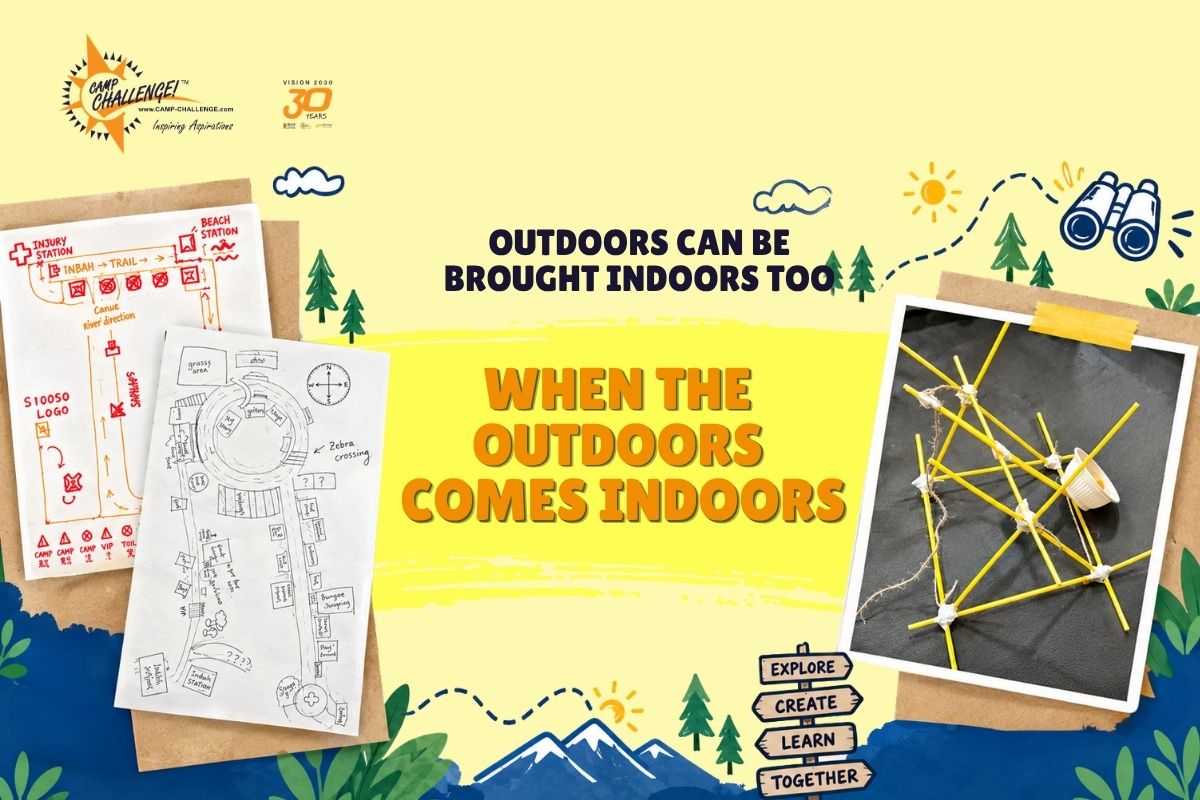
A TREBUCHET… WITHOUT WOOD?
Pioneering activities traditionally call for poles, ropes and plenty of space.
Our challenge? Wooden poles weren’t an option.
So we looked at what was available.
Enter: balloon sticks.
With a little creativity and a lot of teamwork, participants still had to work through the same fundamental challenge — understand the structure, communicate, experiment, make adjustments and figure out what works.
The materials changed. The challenge didn’t.
Navigation Without Leaving the Room?
No trail. No compass. No outdoor landscape.
Instead, participants watched a 5-minute video journey through different locations and were challenged to recreate what they had seen on a map.
They had to observe carefully, remember key landmarks, organise information and work together to piece the journey together.
A simple video became a lesson in observation, communication, spatial awareness and planning.
A FLAG STAND… WITHOUT POLES OR TWINE?
Another activity. Another restriction.
No traditional poles. No twine.
So we reached for something a little less conventional: pool noodles and tape.
What might look like simple, everyday materials suddenly became construction tools. Participants had to think differently, work with what they had and adapt their ideas as they went along.
And isn’t that what outdoor learning is really about?
Resourcefulness isn’t having everything you need.
It’s knowing what to do with what you have.
THE OUTDOORS IS MORE THAN THE OUTDOORS
Even within an indoor environment, participants were still required to make decisions, test ideas, deal with unexpected outcomes and work together towards a common goal.
And then came the part that can sometimes make the biggest difference: the debrief.
Our instructors helped participants connect what happened during the activities to situations beyond the programme — taking responsibility, communicating with others, contributing to a team, and thinking about what they could do differently next time.
Because completing an activity is one thing.
Understanding what the experience teaches you is another.
WHEN CONSTRAINTS BECOME THE CHALLENGE
This programme reminded us that meaningful experiential learning doesn’t always require the perfect environment.
No wooden poles? Find another way.
No twine? Build with something else.
Can’t go outdoors? Bring the experience indoors.
At CAMP CHALLENGE, we believe that sometimes the most interesting programmes begin with a simple question:
What if we can't do it the usual way?”
That’s when the real creativity starts.
Have a programme with restrictions of its own?
Talk to us. We might just have an unconventional way to make the challenge work.